
In my previous blog post titled, ‘From ID to Learning Architecture: A necessary shift’ I had explored what this transition means, why it matters, and how the role of instructional designers is evolving—from content creators to system architects.
In the current blog post, I explain how you go about implementing the same.
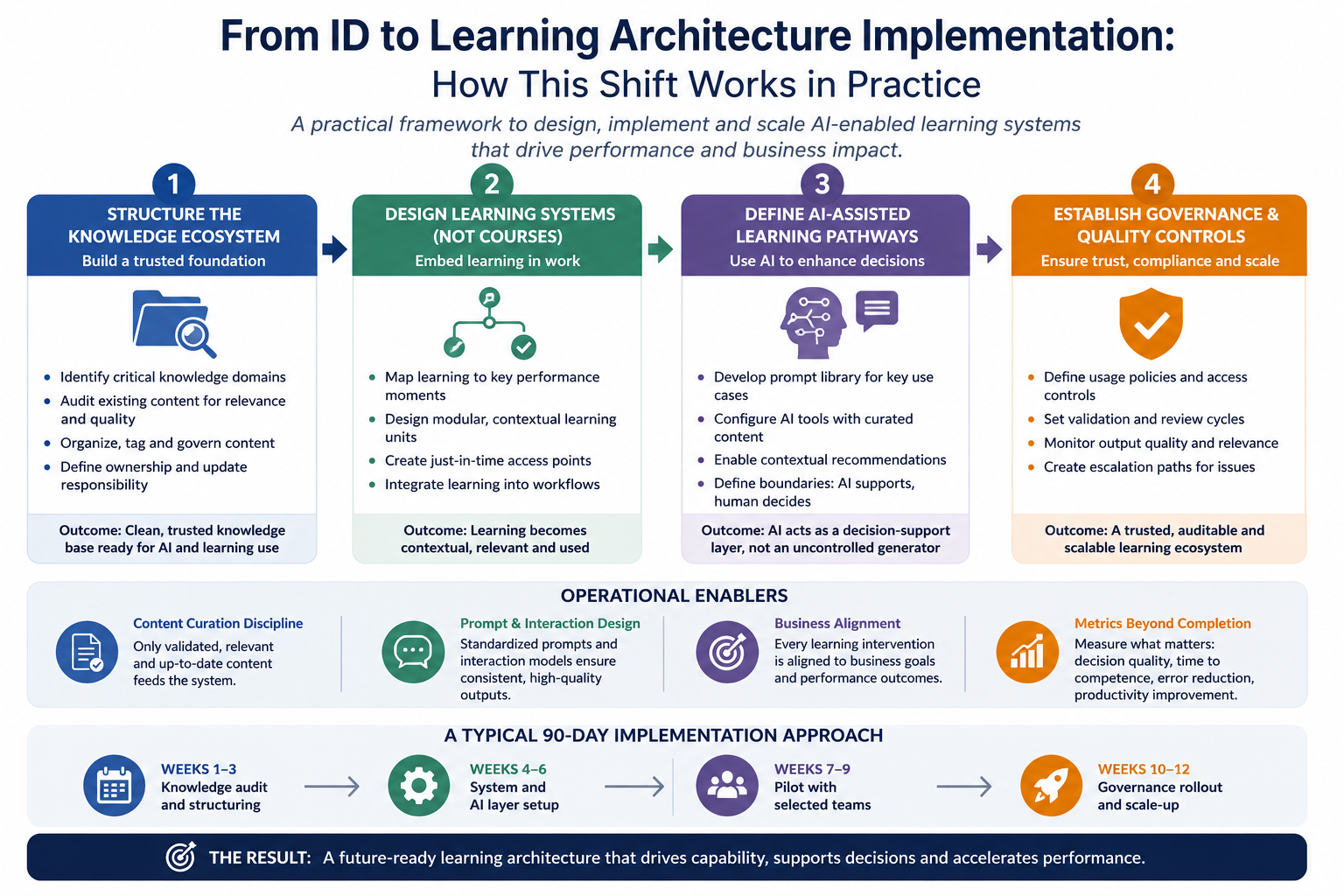
Image generated by AI tool (ChatGPT)
Context Setting
The shift from instructional design to learning architecture is conceptually clear.
However, for most organizations, the real question is practical:
How does this translate into implementation?
Leaders are not looking for terminology.
They are looking for structured, low-risk ways to operationalize this shift.
Therefore, the focus must move from what this means to how it is executed.
Problem Decomposition
When organizations attempt this transition without structure, four challenges typically emerge:
- Efforts remain tool-driven rather than outcome-driven
- AI is introduced without governance or clarity of use
- Content continues to grow, but usability does not improve
- Learning metrics remain unchanged despite new investments
This indicates that the transition requires system design, not tool adoption.
Implementation Framework: A Consultant’s Approach
A practical implementation can be structured across four layers.
Each layer builds on the previous one.
- Structuring the Knowledge Ecosystem
Objective: Create a reliable, usable foundation for AI and learning.
What this involves:
- Identifying critical knowledge domains (e.g., sales, operations, compliance)
- Auditing existing content for relevance and duplication
- Structuring content into governed repositories
- Defining ownership and update responsibility
How it is implemented:
- Conduct a Knowledge Audit Workshop with stakeholders
- Create a content taxonomy and tagging model
- Establish a “source of truth” repository structure
- Archive or eliminate redundant material
Outcome:
A clean, trusted knowledge base that AI can operate on effectively.
- Designing Learning Systems (Not Courses)
Objective: Move from static modules to dynamic learning flows.
What this involves:
- Mapping learning journeys to real work scenarios
- Defining when and how learning is accessed
- Integrating learning into workflows
How it is implemented:
- Identify key performance moments (e.g., onboarding, decision points)
- Replace long courses with modular, contextual learning units
- Design just-in-time access points rather than linear pathways
Outcome:
Learning becomes embedded in work, not separated from it.
- Defining AI-Assisted Learning Pathways
Objective: Use AI to enhance—not replace—learning decisions.
What this involves:
- Designing how AI interacts with knowledge
- Creating structured prompts for consistent outputs
- Enabling contextual recommendations
How it is implemented:
- Develop a prompt library for common use cases:
- Summarization
- Policy interpretation
- Scenario-based guidance
- Configure AI tools (e.g., NotebookLM) with curated content
- Define boundaries: where AI supports, and where human judgment is required
Outcome:
AI becomes a decision-support layer, not an uncontrolled generator.
- Establishing Governance and Quality Controls
Objective: Ensure reliability, compliance, and long-term sustainability.
What this involves:
- Defining usage policies
- Setting validation and review cycles
- Monitoring output quality
How it is implemented:
- Introduce access-based controls for different roles
- Establish quarterly content validation cycles
- Define acceptable use guidelines for AI outputs
- Create escalation paths for errors or inconsistencies
Outcome:
A system that is trusted, auditable, and scalable.
Operational Enablers
To support the above layers, four practical elements are introduced:
- Content Curation Discipline
Not all content is retained.
Only validated, relevant knowledge is included.
- Prompt and Interaction Design
Prompts are standardized to ensure consistency across users.
- Business Alignment Mechanisms
Every learning intervention is linked to a measurable performance outcome.
- Metrics Beyond Completion
Tracking shifts from:
Course completion rates
to
- Decision quality
- Time to competence
- Error reduction
- Productivity improvement
What This Looks Like Over Time
A typical implementation may follow a phased 90-day approach:
- Weeks 1–3: Knowledge audit and structuring
- Weeks 4–6: System and AI layer setup
- Weeks 7–9: Pilot with selected teams
- Weeks 10–12: Governance rollout and scale-up
This ensures progress without organizational disruption.
Stabilizing Close
This shift is not about replacing instructional design practices.
It is about repositioning them at a systems level.
When implemented thoughtfully, this approach does three things:
- Reduces dependency on fragmented content
- Enhances decision-making capability
- Builds a sustainable learning ecosystem
A useful reflection at this stage is:
Is your current learning approach designed to deliver content—or to enable consistent, high-quality decisions?
The answer to that question often defines the starting point for implementation.
#LearningSystems #KnowledgeManagement #AIImplementation #LearningAndDevelopment #OrganizationalCapability #BusinessTransformation #Consulting