
You do not need a perfect platform to begin a Learn-to-Earn programme. You need a clearly defined skill, a small learner cohort, and a simple incentive loop. This 90-day playbook explains how organisations can pilot a micro-credential programme without over-engineering the technology or attempting to transform everything at once.
Why begin with a 90-day pilot?
Large learning transformations often lose momentum because they try to change too much, invest in technology before testing the learning design, and delay visible results. A focused 90-day pilot reduces these risks by concentrating on one high-value skill with 20–50 learners.
The pilot should generate practical evidence about learner engagement, skill transfer, manager feedback, credential value, and operational feasibility. This evidence can then support a decision about whether to improve, replicate, or scale the model.
Step 1: Choose a focused skill
Avoid broad themes such as “leadership” or “digital skills.” Select one specific skill that can be practised and assessed within four to eight weeks. Examples include:
- Running effective one-on-one meetings for new managers.
- Giving clear, actionable feedback in project teams.
- Using data storytelling with non-technical audiences.
- Facilitating inclusive meetings for team leads.
A suitable pilot skill should have three qualities:
- High impact: It can improve performance, retention, collaboration, or customer experience.
- Observable: Effective performance can be described through concrete behaviours.
- Time-bounded: Learners can practise and demonstrate it within the pilot period.
Ask: If this skill improved measurably within 90 days, where would we see the difference?
Step 2: Design the micro-credential
The credential should represent demonstrated capability, not simply course completion. Begin with a clear competency statement, such as:
“Learners can facilitate inclusive meetings that increase participation and psychological safety, as demonstrated through observed practice and peer feedback.”
Next, define the evidence required. This may include meeting agendas, facilitation plans, project outputs, reflection notes, peer or manager observations, and short participant surveys.
Set transparent criteria for earning the credential. For example, a learner seeking an “Inclusive Meeting Facilitation – Practitioner” credential might need to:
- Facilitate at least three meetings using agreed practices.
- Collect feedback after each meeting.
- Achieve a defined score on an inclusion rubric.
- Submit a brief reflection explaining what changed and why.
These criteria make the credential meaningful, assessable, and connected to workplace performance.
Step 3: Select the credential layer
An organisation does not need to build a blockchain from scratch. The immediate requirement is a verifiable and portable record of achievement.
Possible approaches include existing verifiable-credential platforms, blockchain-backed certificates, soulbound tokens, or a technology-light pilot using signed digital certificates and a verification page. If the pilot proves successful, the organisation can later migrate to a more advanced blockchain-based system.
When evaluating a credential provider, consider whether credentials can be verified independently, shared through LinkedIn or personal websites, and controlled through selective disclosure. For an initial pilot, a simple, reliable, and verifiable solution is better than a perfect system that delays implementation.
Step 4: Build the learning and incentive loop
The progression should be simple and visible:
- Learn: Complete a workshop or short learning module.
- Practice: Apply the skill in real work.
- Assess: Submit evidence and receive feedback.
- Earn: Receive the micro-credential and, where appropriate, an additional reward.
- Show: Add the credential to a professional profile, portfolio, or internal talent system.
Feedback should be provided immediately after practice wherever possible. Include a midpoint check-in with a manager or coach and an end-of-pilot reflection.
Rewards might include a credential, a coaching session, access to an advanced course, internal recognition, or participation in a professional community. The reward should represent a meaningful milestone in the learner’s development—not a speculative prize.
Step 5: Run the 90-day pilot
Days 1–10: Prepare
Finalise the skill definition, evidence requirements, assessment rubric, credential process, and learner cohort. Recruit 20–50 participants and brief managers on their role in encouraging practice, providing feedback, and recognising progress.
Days 11–40: Learn and practise
Deliver the learning module or workshop. Learners begin applying the skill in their day-to-day work. Collect early feedback and provide job aids, coaching, or peer support where necessary.
Days 41–60: Assess and credential
Learners submit their evidence, including artefacts, feedback, observations, and reflections. Managers, L&D professionals, or trained reviewers assess the evidence against the agreed rubric. Issue credentials and rewards to learners who meet the criteria.
Days 61–90: Review and decide
Analyse completion and credentialing rates, learner confidence, behaviour change, manager observations, and perceived credential value. Conduct a retrospective with learners and managers to identify what worked, what felt useful, and what should change before scaling.
Measuring success
A short pilot should seek directional evidence rather than statistical perfection. Track:
- Engagement: Learners who start, practise, and complete the assessment.
- Skill transfer: Changes in manager ratings, observed behaviour, and learner confidence.
- Perceived value: Whether learners consider the credential meaningful and want future opportunities.
- Operational feasibility: Time required for assessment, credential issuance, and support.
Even modest improvements in confidence, observable behaviour, and interest in a second pilot may justify further investment.
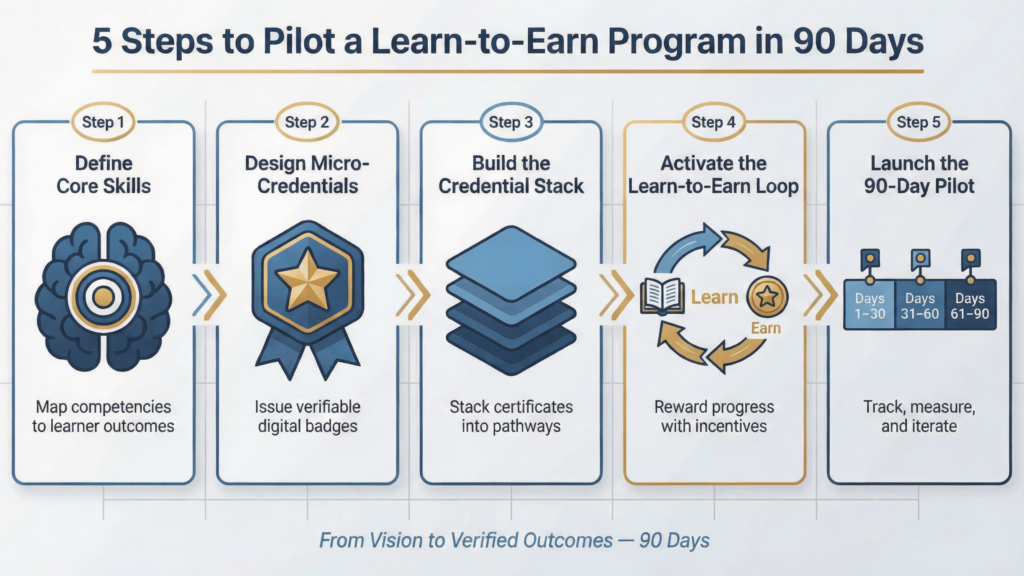
Image generated by AI based on my prompt
Common objections
“We cannot afford blockchain.” Begin with signed digital certificates and a verification page. The core innovation is the learning, assessment, and incentive design—not the technology used on day one.
“Our employees will not care about tokens or badges.” They may not value them in isolation. Link them to coaching, advanced learning, career visibility, internal projects, or professional communities.
“We cannot assess behaviour at scale.” Start with a small cohort, simple rubrics, and manager or peer input. Improve the process as participation grows.
The complete Learn-to-Earn model
Across the series, the Learn-to-Earn model has covered four connected elements:
- Vision: Building ecosystems for verifiable skills.
- Trust: Using portable, tamper-resistant credentials.
- Incentives: Rewarding mastery rather than activity.
- Execution: Testing the model through a focused 90-day pilot.
Together, these elements help organisations turn learning into visible, valuable, and learner-owned capability. The recommended starting point is simple: choose one team, one skill, one cohort, and one meaningful incentive loop.
If you ran a 90-day Learn-to-Earn pilot in your organisation, which one skill would you start with, and what reward would feel genuinely meaningful to your learners?
#LearnToEarn #MicroCredentials #CorporateLearning #L&D #EdTech #LeadershipDevelopment #FutureOfWork #SkillBasedLearning #BlockchainInEducation #PilotProgram #InnovationInLearning #TalentDevelopment #WorkplaceLearning #DigitalCredentials #LearningAndDevelopment