
This is the second article in a four-part series exploring how blockchain, micro-credentials, and gamified incentives can make learning more visible, portable, and connected to real skills.
Imagine a leadership credential that cannot be bought, copied, or transferred, but can only be earned through demonstrated capability.
That is the potential of soulbound tokens (SBTs) for education and professional learning. In a Learn-to-Earn ecosystem, they can help shift the conversation from:
“I completed a course.”
to:
“Here is verifiable evidence of what I can do.”
What are soulbound credentials?
A soulbound token is a non-transferable digital credential linked to an individual’s identity or digital wallet.
Unlike a tradable NFT, it is not designed to be sold, gifted, or transferred. It represents a person’s verified achievement, contribution, membership, or reputation.
In learning and development, an SBT could represent:
- A degree or diploma.
- A professional certification.
- A skill-based micro-credential.
- Verified work experience or project contribution.
- Continuing professional development.
- Mentoring or peer-learning contributions.
The credential remains connected to the learner and can be verified when required.
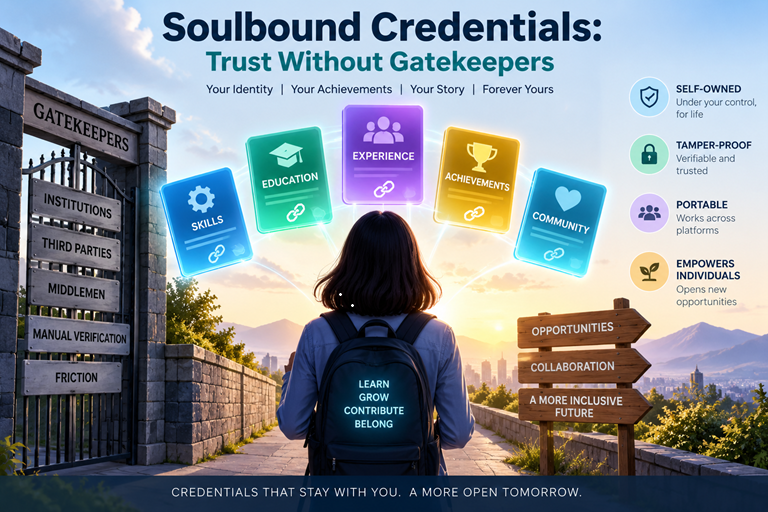
Image Source: Created by AI based on my prompt.
Why they matter for learning
Traditional certificates remain valuable, but they do not always show the specific skills a learner can apply. They may also be difficult to verify or scattered across different institutions, platforms, and employers.
Soulbound credentials can complement traditional certificates by offering:
- Learner ownership: The record can remain accessible to the learner instead of being held only by one institution or employer.
- Verifiability: An authorised employer or institution can confirm that the credential came from a trusted issuer.
- Portability: Credentials from different providers can form one professional learning portfolio.
This is especially useful for professionals who move between roles, organisations, industries, or countries.
A leadership example
Consider a corporate programme focused on effective feedback.
The organisation identifies “Feedback That Sticks” as an important capability for new managers. To earn the credential, participants must:
- Structure feedback using an agreed model.
- Conduct a real feedback conversation.
- Gather feedback from the recipient or peers.
- Reflect on the experience and identify improvements.
After meeting the criteria, the manager receives a credential titled:
Feedback That Sticks, Practitioner
The credential may include the issuer, date of issue, competency description, and a secure reference to supporting evidence.
Over time, the manager could earn additional credentials in:
- Conflict de-escalation.
- Coaching conversations.
- Inclusive team leadership.
- Strategic decision-making.
Together, these credentials form a leadership portfolio that shows demonstrated behaviours, not just job titles or course completion.
Making credentials portable
For soulbound credentials to work across systems and borders, three conditions are important:
- Common standards: Providers need shared ways to describe skills, evidence, and achievement levels.
- Interoperable systems: A credential issued by one institution should be understandable and verifiable by another.
- Recognition frameworks: Employers, universities, and professional bodies need confidence in what each credential represents.
The long-term goal is to enable learners to present verified credentials to employers or institutions without lengthy manual checks.
Privacy and learner control
A learner should not need to reveal their entire education or work history to prove one capability.
Well-designed credential systems can support:
- Selective disclosure: Sharing only the credential relevant to a specific opportunity.
- Permissioned access: Restricting sensitive information to authorised individuals.
- Minimal on-chain data: Storing sensitive evidence securely off-chain while using blockchain to verify authenticity.
For example, a manager could share leadership credentials during a promotion process without disclosing unrelated learning records.
Governance builds trust
Technology alone does not make a credential credible. Trust depends on the issuer, assessment process, and governance rules.
Organisations should define:
- Who can issue credentials.
- What evidence is required.
- How competencies are assessed.
- How standards are reviewed.
- How errors, disputes, or revocations are handled.
- How learner data is protected.
Universities, accredited training providers, professional bodies, and corporate academies can all serve as trusted issuers.
Strong governance helps ensure that soulbound credentials remain meaningful signals of capability rather than becoming digital badges without real value.
What organisations can gain
For L&D, higher education, and vocational training leaders, soulbound credentials can provide:
- Reduced verification effort: Less dependence on manual checks and disconnected records.
- Stronger talent signals: Clearer evidence of what people can do.
- A lifelong learning foundation: A learner-owned portfolio that grows across roles and career stages.
Organisations do not need to begin with a large technology investment. A practical starting point is to select one high-value capability, define its evidence requirements, and test the model with a small group.
What comes next
The first article introduced the vision for Learn-to-Earn ecosystems.
This article explored how soulbound credentials can create trusted and portable records of capability.
The next article will examine how to design incentives that encourage meaningful learning rather than superficial activity.
Your perspective
If your organisation could issue one soulbound credential tomorrow, what skill or behaviour would you recognise first?
Would it be a leadership capability, a technical skill, or a cross-functional competency such as collaboration, data literacy, or mentoring?
Share your thoughts in the comments.
#BlockchainInEducation #SoulboundTokens #MicroCredentials #EdTech #LeadershipDevelopment #LAndD #FutureOfWork #HigherEd #CorporateLearning