
Most organizations have invested significantly in learning platforms, collaboration tools, and knowledge repositories.
Yet an important question remains:
Are we managing training, or are we managing organizational knowledge?
Learning platforms are effective for delivering content, tracking completion, and supporting employee development. However, the knowledge that drives organizational performance extends far beyond formal training.
It includes:
• Subject matter expertise
• Project learnings and lessons learned
• Policies, procedures, and standards
• Customer insights
• Best practices and operational know-how
• Institutional memory accumulated over years
Unfortunately, much of this knowledge remains fragmented across shared drives, emails, collaboration platforms, and individual employees.
This is where the conversation must evolve—from Learning Management to Learning Intelligence.
Creating an organizational knowledge ecosystem involves:
• Capturing critical business knowledge
• Structuring it into trusted repositories
• Establishing governance and ownership
• Enabling AI-assisted retrieval, synthesis, and decision support
With emerging AI-enabled knowledge management platforms, organizations can move beyond storing information to enabling:
✔ Faster access to expertise and insights
✔ Cross-functional knowledge sharing
✔ Better and faster decision-making
✔ Reduced duplication of effort
✔ Preservation of institutional knowledge
✔ AI-assisted support for employees and leaders
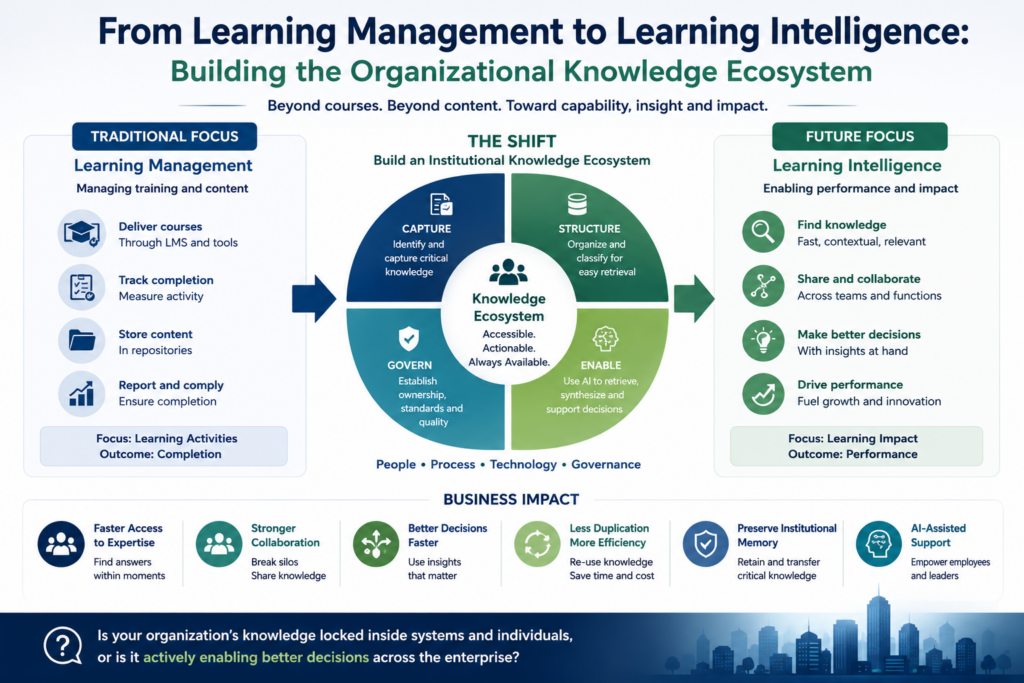
Image created by ChatGPT based on my prompt
The future is not simply about managing content.
It is about creating a knowledge ecosystem where information becomes accessible, actionable, and continuously available to support performance, innovation, and growth.
A useful reflection:
Is your organization’s knowledge locked inside systems and individuals, or is it actively enabling better decisions across the enterprise?
#KnowledgeManagement #LearningIntelligence #OrganizationalLearning #DigitalTransformation #ArtificialIntelligence #KnowledgeSharing #BusinessTransformation #FutureOfWork #Leadership #OrganizationalCapability