
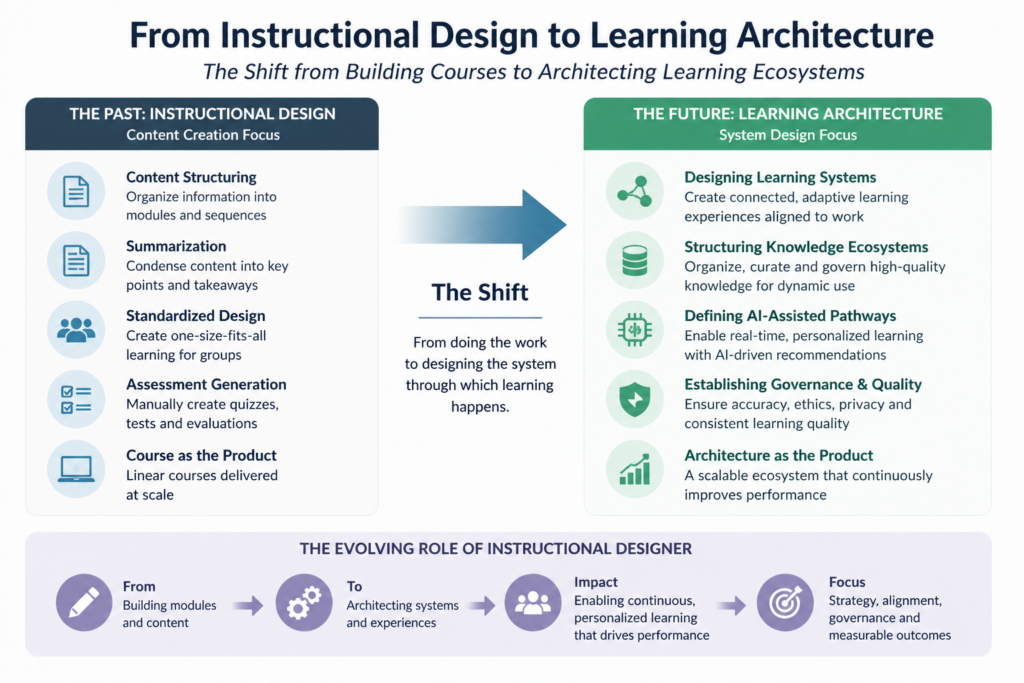
Image henerated by AI
Context Setting
For many years, instructional design has been a cornerstone of organizational learning.
It translated expertise into structured, scalable learning experiences.
This work required rigor.
It required judgment.
It required deep understanding of both content and learners.
Today, that context is changing.
“Artificial Intelligence systems are increasingly capable of performing tasks that once defined the instructional design function—such as content structuring, summarization, personalization, and even assessment generation.”
As a result, the question is not whether instructional design remains valuable.
The question is how its value must evolve.
Problem Decomposition
The shift underway can be understood across four key changes:
- From Scarcity of Content to Abundance
Earlier, the challenge was creating enough structured content.
Now, content can be generated rapidly and at scale.
This reduces the centrality of course creation as the primary output.
- From Standardization to Personalization
Traditional instructional design focused on standardized modules.
AI enables real-time, individualized learning pathways.
This changes the unit of design—from courses to adaptive experiences.
- From Manual Processes to Automated Translation
Tasks such as:
- Performance consulting inputs
- SME coordination
- Content authoring
are increasingly supported or automated by AI systems.
This does not eliminate expertise.
However, it changes where that expertise is applied.
- From Products to Systems
Previously, the “course” was the end product.
Now, value shifts toward designing learning ecosystems—where content, AI, data, and workflows interact continuously.
A New Lens: Learning as Architecture
To respond effectively, instructional design must be reframed.
Not as content creation.
But as system design.
This involves three interconnected layers:
- Knowledge Layer
- What content exists
- How it is structured
- How it is maintained and governed
- Experience Layer
- How learners interact with knowledge
- How personalization occurs
- How feedback loops are designed
- Intelligence Layer
- How AI supports decision-making
- How recommendations are generated
- How learning adapts over time
The role shifts from building modules to aligning these layers coherently.
Practical Application: What This Means for Instructional Designers
For instructional designers, this transition is not a loss of relevance.
It is a shift in focus.
From:
- Designing courses
- Writing content
- Managing linear learning flows
To:
- Designing learning systems
- Structuring knowledge ecosystems
- Defining AI-assisted learning pathways
- Establishing governance and quality controls
In practical terms, this includes:
- Curating high-quality source content
- Designing prompts and interaction models for AI
- Ensuring alignment with business and performance goals
- Defining metrics for learning effectiveness beyond completion rates
This is more complex work.
It is also more strategic.
What Remains Constant
It is important to acknowledge:
The foundational skills of instructional design are not obsolete.
Understanding how people learn.
Structuring information meaningfully.
Designing for clarity and retention.
These remain essential.
However, they must now be applied at a systems level, not just at a content level.
Stabilizing Close
The evolution underway is not about replacing instructional designers.
It is about expanding their scope.
Those who continue to focus only on “building modules” may find their role narrowing.
Those who begin to think in terms of architecting learning ecosystems will find new relevance.
This is not a disruption to resist.
It is a transition to engage with thoughtfully.
This raises an important reflection:
In your current role, are you designing learning content—or shaping the system through which learning happens?
#InstructionalDesign #LearningArchitecture #FutureOfLearning #AIinLearning #LearningStrategy #WorkplaceLearning